

Running a business in Colombia involves more than just managing operations—it also requires compliance with strict payroll and labor laws. For employers, understanding payroll taxes, social security contributions, and compliance requirements is crucial to avoid penalties and maintain a healthy relationship with employees. This guide provides a comprehensive overview of how payroll works in Colombia, ensuring your business meets all its obligations.
Key Components of Payroll in Colombia
Payroll in Colombia includes several mandatory components that employers must calculate, withhold, and remit. These include:
Salaries and Wages
- Employers must pay at least the minimum monthly salary set by the government. In 2024, the minimum wage is COP $1,200,000 (subject to annual adjustments).
Social Security Contributions
- Contributions to Colombia’s social security system include health insurance (EPS), pensions, and occupational risk insurance (ARL).
Parafiscal Contributions
- Employers contribute to funds supporting employee benefits, such as family allowances, job training, and social welfare.
Vacation Pay
- Employees are entitled to 15 paid vacation days for every year worked.
Severance Pay (Cesantías)
- Employers must deposit one month’s salary per year into a severance fund.
Payroll Taxes and Withholdings
- Taxes on salaries, including income tax withholdings, must be calculated and remitted to the appropriate authorities.
Breakdown of Social Security Contributions
Employers and employees share the responsibility for funding Colombia’s social security system:
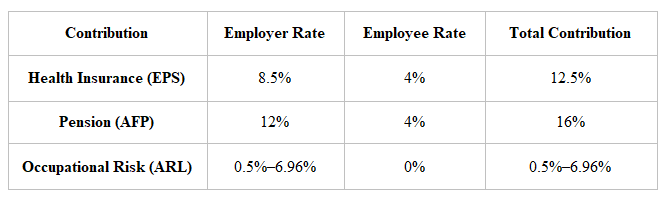
Key Notes:
- The occupational risk rate depends on the employee’s job risk level.
- Employers are responsible for calculating and remitting both employer and employee contributions.
Parafiscal Contributions
Employers must also contribute to parafiscal funds:
- Family Welfare Fund (Caja de Compensación Familiar): 4%
- National Learning Service (SENA): 2%
- Colombian Institute of Family Welfare (ICBF): 3%
These contributions support employee benefits and training programs.
Additional Payroll Requirements
Transportation Allowance:
- Employees earning up to two times the minimum wage are entitled to a transportation allowance (COP $140,606 in 2024).
Overtime Pay:
- Employers must compensate employees for overtime, night shifts, and work on holidays at higher rates.
Payroll Reporting (Planilla Integrada de Liquidación de Aportes – PILA):
- All payroll contributions must be reported and paid through the PILA system, an electronic platform managed by the government.
Tax Withholding Obligations
Income Tax Withholding (Retención en la Fuente):
- Employers must withhold income tax from employee salaries based on
- Colombia’s progressive tax rates.
- The withholding amount depends on the employee’s income level and personal deductions.
Other Deductions:
Withholdings for court-ordered obligations, loans, or union dues, if applicable.
Payroll Compliance Requirements
Employment Contracts:
- Employers must formalize all employee relationships with written contracts specifying salary, duties, and benefits.
PILA System Registration:
- Businesses must register with the PILA system to report and pay payroll contributions.
Accurate Record-Keeping:
- Maintain detailed payroll records for at least five years, including payment receipts, contracts, and contribution reports.
Timely Payments:
- Payroll contributions and withholdings must be remitted on or before the due dates set by the government.
Adherence to Labor Laws:
- Ensure compliance with Colombia’s labor code, including mandatory benefits, work hours, and termination policies.
Penalties for Non-Compliance
Failing to comply with payroll obligations can lead to significant penalties, including:
Fines:
- Late or missing payments for social security and parafiscal contributions can result in fines and interest.
Labor Disputes:
- Non-compliance with labor laws may lead to lawsuits or complaints from employees.
Government Sanctions:
- Persistent non-compliance can result in audits or sanctions by Colombian authorities.
Tips for Streamlining Payroll Management
Automate Payroll Processes:
Use payroll software or hire a payroll management service to ensure accurate calculations and timely payments.
Stay Updated on Regulations:
Colombian labor laws and contribution rates are subject to change. Regularly review updates from DIAN and other authorities.
Work with Professionals:
Engage a payroll management expert to navigate the complexities of compliance and reporting.
Train Your HR Team:
Educate your HR personnel on the intricacies of Colombian payroll and labor laws to minimize errors.
How Colombia Tax Can Help
Managing payroll in Colombia can be complex, but our experts make it easy for your business:
- Calculate salaries, contributions, and withholdings accurately.
- Ensure compliance with social security and parafiscal obligations.
- Handle PILA reporting and payments on your behalf.
- Provide guidance on labor laws and employee benefits.
- Maintain detailed payroll records and documentation.
Contact us today to schedule a consultation and let us simplify your payroll operations. With Colombia Tax, you can focus on growing your business while we handle the complexities of payroll management in Colombia.